The Curious Case of ... Dopamine & Wanting vs Liking
In the summer of 1954, in a laboratory at McGill University, a young researcher named James Olds lowered a fine wire into the brain of a rat and missed.
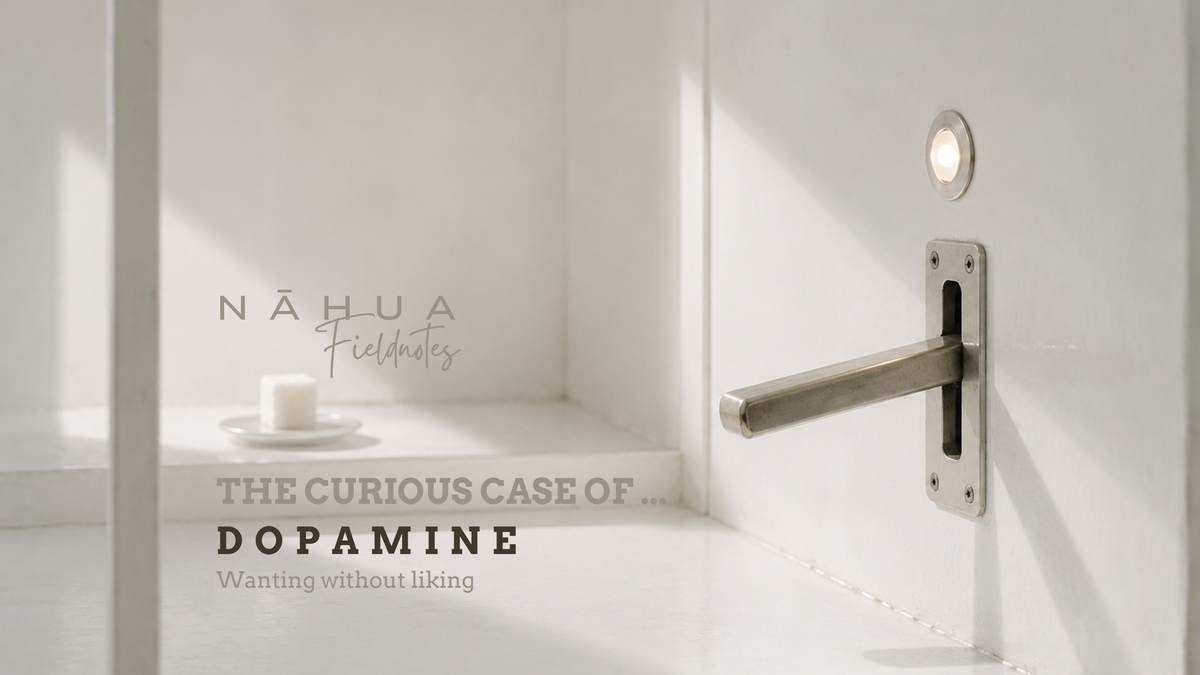
He had been aiming for a structure involved in arousal, in the brain's waking systems. The electrode landed nearby instead. James Olds was still new to the surgery; Peter Milner, his collaborator, had taught him the technique only recently. They expected the current to feel unpleasant. Whenever the rat strayed into one corner of its box, they switched it on, anticipating the animal would learn to keep away.
The rat went back to the corner.
Then it went back again. It behaved as though that corner were the most interesting place in the world, which, from the inside, it may well have been. Olds and Milner rigged the current to a lever the rat could press for itself, and the animal pressed it. Then it pressed it again, hundreds of times an hour. In the experiments that followed over the next few years, rats would press these levers thousands of times an hour, cross electrified floors they would otherwise have refused to touch, and ignore food to keep pressing.
None of it was supposed to happen. The wire had missed, and the place it strayed into instead was circuitry where the current was something to chase rather than flee. The interpretation wrote itself. Olds and Milner had found the pleasure center.
The Myth That Ran the Table
It was the same move Rudolf Virchow had made at his microscope a century before: a real discovery and an explanation logical enough to survive for decades whether or not it was right. Olds had a genuine phenomenon in his hands. What the rat was doing, though, turned out not to be what everyone assumed it was doing.
The story that grew out of that rat in the corner became one of the most successful ones neuroscience told in the late twentieth century. Dopamine, the chemical eventually placed at the center of these circuits, was the pleasure molecule. Get the reward, release dopamine, feel good, repeat. It explained sex and drugs and money and dessert in a single stroke, and it threw in a tidy account of why people keep doing the things they later regret. It had everything a culture could want from a molecule.
It was also wrong. It took forty years for this pleasure molecule myth to be exposed as a fiction because that early experiment and so many that followed all really did seem to prove it.
Do me a favor: every word you have absorbed about dopamine hits, dopamine detoxes, dopamine fasts, dopamine menus? Pretend you have never heard any of it. We will come back to it.
Measuring the Wrong Thing
It was not a foolish thing to believe. Stand in the decades after Olds, look at what kept turning up, and you, too, would swear the pleasure molecule was real.
Animals would work for brain stimulation harder than they worked for almost anything else. The drugs people loved and could not leave alone, cocaine and amphetamine above all, acted directly on dopamine systems. Take dopamine away and motivated behavior fell apart; Parkinson's patients, their dopamine neurons dying, lost not only movement but drive. Flood the same system and you got euphoria, then compulsion. Reward learning ran through it. So did the pharmacology of the antipsychotics. Wherever reward seemed to matter, dopamine was in the room.
Roy Wise (1982) gave the intuition its sharpest form with the anhedonia hypothesis. Blunt an animal's dopamine and it works less for its rewards. Therefore dopamine must be carrying the pleasure itself. Block the chemical, lose the joy, lose the reason to bother. Every result lined up behind it.
There was a crack, and it was quiet enough to sit unnoticed for years. Every one of those experiments measured the same thing. They measured whether the animal would work: press the lever, cross the floor, run the maze, choose the cup. Not one of them measured what the animal felt. Wanting was being scored as liking, study after study, and because nobody had a way to pull the two apart, the question of whether they were even the same thing could not yet be asked.
The instrument that finally separated them had been hiding in plain sight since 1978.
Reading Pleasure on the Face
That year, Harvey Grill and Ralph Norgren (1978) described something simple and useful: a rat's face does legible things when the rat tastes something. Drip sugar water onto its tongue and you get a specific rhythmic pattern, tongue protrusions, licking of the lips and paws. Drip something bitter and you get a different pattern just as specific, gapes, headshakes, the chin dragged along the floor. The reactions are stereotyped and automatic. The animal is not performing them for anyone. They are what pleasure and disgust look like from the outside.
And they are old. The same reactions appear in rats, in monkeys, and in human newborns, including infants who have never tasted anything before (Steiner 1973). That is what "conserved" means in plain language: wired in long before us, shared down a deep branch of the tree, not learned and not optional.
Kent Berridge saw what this gave him. Here was a window onto liking that did not depend on whether the animal could be bothered to chase anything. You could place a drop of sucrose in the mouth of an animal that was seeking nothing and going nowhere, and read its pleasure straight off its face. It was the tool that finally separated eating from enjoying, the same way, in the first essay in this series, cytokines became the instrument that revealed a conversation nobody had been able to hear.
How a Hypothesis Dies
Then Berridge turned the tool on Wise's hypothesis, and the hypothesis did not survive the encounter.
Strip the dopamine out of a rat's brain and the animal goes profoundly aphagic, a result Urban Ungerstedt (1971) had established years earlier. It stops seeking. It stops eating. It will sit and starve in front of a heap of food. By every motivational measure it looks devastated, exactly as the anhedonia hypothesis predicts. But put sucrose directly in its mouth and the liking reactions come back whole (Berridge, Venier, and Robinson 1989). The rhythmic tongue protrusions, all of it, fully intact. Pleasure had survived the total loss of dopamine.
That was the demolition charge. The other half of the proof runs the opposite way and lands in the same place. Drive dopamine up, with amphetamine in the relevant circuit, and you amplify how hard an animal will work for a cue, how fiercely it wants, without lifting the liking reactions to match (Wyvell and Berridge 2000). Remove dopamine: liking stays, wanting collapses. Add dopamine: wanting climbs, liking sits still.
Dopamine had not been caught making pleasure. It had been caught making pursuit.
Dopamine was never the pleasure molecule. It was closer to the thing that made the world matter, that turned a neutral room into one with a target in it. It did not make things feel good. It made things wanted.
The Grip That Remains
Which means "reward," the word everyone had been using as though it named one thing, had been hiding more than one process the whole time. At least two of them carry this story. Liking, the hedonic hit, the part the face reports. And wanting, the pull toward the thing, the part the lever reports. (Learning is a third, and we can leave it mostly aside.) Berridge and Robinson (1998) gave the wanting component a name, incentive salience, the property by which a cue lights up and acquires a grip, the thing that converts there it is into go get it.
Most of the time the two move together and you never notice the seam. The food smells good, you want it, you eat it, you enjoy it, the loop closes and resets. But the machinery can come apart, and the moment it does, behavior that looked baffling turns legible. The smoker who wants the cigarette and despises being a smoker. The drinker who wants the drink long after the drink stopped being any fun. The gambler who wants the next hand inside a life the last thousand hands already wrecked.
The folk account cannot hold these people. It says we repeat a behavior because it feels good, so when the behavior plainly stops feeling good, the account reaches for other words: weakness, denial, a death wish. Robinson and Berridge (1993) offered a cleaner one. Repeated exposure to a drug can sensitize the very system that assigns the pull, so that the cues and contexts around it become pathologically wanted even as the drug itself is liked less and less. The wanting grows teeth while the liking quietly leaves the room.

Addiction is a wanting system that has learned to shout in the absence of pleasure, and the terrifying part is not that pleasure wins, it is that pleasure may no longer be meaningfully in the room.
Pursuit Without Payoff
It would be comfortable to leave that with the addict, who has the advantage of being someone else. But the smoker who hates smoking and the achiever reaching for the next milestone are running the same machine, and if you are the kind of person who reads essays like this one, you are far likelier to be the second than the first. Early on, the win lands. Wanting and liking are coupled, you go after the thing, you reach it, and it gives something back. Later the cue keeps its grip and the chase stays beautifully organized, the targets still acquired, the calendar still full, while the reward thins toward nothing. Relief arrives where pleasure used to be. Continuation stands in for completion. You close the deal and feel, instead of joy, a brief loosening of pressure before the next target lights up and starts to pull.
This is what the Signal Loss Model names Pursuit-Reward Decoupling: pursuit and reward have come apart, and the person stays mobilized toward objects that no longer restore them. The wanting does not switch off, because wanting was never the same thing as liking. Berridge is what turns that from a nice metaphor into a claim with a mechanism under it.
A caution before this runs away with itself. We are not saying dopamine explains achievement culture, or that ambition is a lesion. We are saying the architecture rhymes, and that the rhyme is not a coincidence.
The Ibiza of the Brain
It would be easy to swap one tidy story for another and walk away announcing that dopamine is the wanting molecule, as settled as Wise's readers were in 1982. That would be a mistake. Dopamine is not only wanting either. Wolfram Schultz's recordings showed dopamine neurons firing to the gap between the reward expected and the reward received, a prediction-error signal that became its own enormous literature (Schultz, Dayan, and Montague 1997). It turns up in vigor, in movement, in learning, in the willingness to spend effort against resistance. Wanting is a real and large improvement over pleasure, and it should not be allowed to calcify into the next cartoon the way pleasure did.
As for where pleasure actually lives, the answer turned out to be small and oddly specific. Berridge and Morten Kringelbach (2015) mapped what they call hedonic hotspots, sites about a cubic millimeter across in the shell of the nucleus accumbens and in the ventral pallidum, running on opioid and endocannabinoid signaling rather than on the big, robust dopamine system everyone had spent decades pointing at. Pleasure was real and locatable. It was simply nowhere near where the story had filed it.
And here the first essay in this series circles back. Inflammation reaches into exactly this machinery. Jennifer Felger and Michael Treadway (2017), whose work sits in that essay's references, traced how inflammation acts through dopamine to flatten motivation and effort. The slow fire from the inflammation essay can scoop the drive out of a person the way Ungerstedt's toxin scooped it out of a rat. The same wanting system, reached from two directions, a misplaced electrode from one side and a cytokine from the other.
The answer was not that dopamine is pleasure, and not even that dopamine is wanting. Reward had been hiding several processes inside one word.
The Slogan That Broke the Map
Now pick up that dopamine business I asked you to set aside.
The whole popular apparatus, the habit apps and the productivity coaches and the dopamine-fasting protocols and the explainer threads with their confident little diagrams, kept the pleasure-chemical story running for years after Berridge had taken it apart. The reason is not mysterious. "Pleasure chemical" fits on a mug. "The cue that lights up and says go get it" does not.
The flattening did more than smooth out a detail. It broke the one part with all the explanatory power in it, the part about cue-triggered pursuit, about motivational grip, about the conversion of there it is into go get it. That is the part that tells you why the gambler returns and why the achiever cannot stop, and it is precisely the part that disappears when wanting and liking get mashed back together into a single feel-good signal. The wellness business took a hard-won distinction, one that is still being worked out, and sold it back as a slogan. The slogan does real harm, because it tells a person to manage a feeling when the actual lever is a relationship between two systems they were never told existed. You cannot fast your way out of a coupling problem nobody has let you see.
This is the precise reason this readership learned to flinch at the confident, simplified version of any science. On this one, the flinch was correct.
What Nāhua does with all of this is not to manufacture a better slogan about dopamine. It is to help a person look clearly at their own pursuits and sort them: which still return something, which now return only relief, and which have hardened into cue-driven loops they have come to mistake for identity. Desire gets treated as data rather than as truth. That you still want a thing is real information about your wanting system. It is not, on its own, evidence that the thing is good for you, or that arriving will give anything back.
What Still Gives Back
The rat still likes the sugar. The addict still wants the drug. The achiever still wants the summit. So maybe the question is not "what do you want." Try "what still gives back."
References
Berridge, Kent C., Isabel L. Venier, and Terry E. Robinson. 1989. "Taste Reactivity Analysis of 6-Hydroxydopamine-Induced Aphagia: Implications for Arousal and Anhedonia Hypotheses of Dopamine Function." Behavioral Neuroscience 103 (1): 36–45.
Berridge, Kent C., and Terry E. Robinson. 1998. "What Is the Role of Dopamine in Reward: Hedonic Impact, Reward Learning, or Incentive Salience?" Brain Research Reviews 28 (3): 309–369.
Berridge, Kent C., and Morten L. Kringelbach. 2015. "Pleasure Systems in the Brain." Neuron 86 (3): 646–664.
Felger, Jennifer C., and Michael T. Treadway. 2017. "Inflammation Effects on Motivation and Motor Activity: Role of Dopamine." Neuropsychopharmacology 42 (1): 216–241.
Grill, Harvey J., and Ralph Norgren. 1978. "The Taste Reactivity Test. I. Mimetic Responses to Gustatory Stimuli in Neurologically Normal Rats." Brain Research 143 (2): 263–279.
Olds, James, and Peter Milner. 1954. "Positive Reinforcement Produced by Electrical Stimulation of Septal Area and Other Regions of Rat Brain." Journal of Comparative and Physiological Psychology 47 (6): 419–427.
Robinson, Terry E., and Kent C. Berridge. 1993. "The Neural Basis of Drug Craving: An Incentive-Sensitization Theory of Addiction." Brain Research Reviews 18 (3): 247–291.
Schultz, Wolfram, Peter Dayan, and P. Read Montague. 1997. "A Neural Substrate of Prediction and Reward." Science275 (5306): 1593–1599.
Steiner, Jacob E. 1973. "The Gustofacial Response: Observation on Normal and Anencephalic Newborn Infants." Symposium on Oral Sensation and Perception 4: 254–278.
Ungerstedt, Urban. 1971. "Adipsia and Aphagia after 6-Hydroxydopamine Induced Degeneration of the Nigro-Striatal Dopamine System." Acta Physiologica Scandinavica 82 (S367): 95–122.
Wise, Roy A. 1982. "Neuroleptics and Operant Behavior: The Anhedonia Hypothesis." Behavioral and Brain Sciences 5 (1): 39–53.
Wyvell, Cindy L., and Kent C. Berridge. 2000. "Intra-Accumbens Amphetamine Increases the Conditioned Incentive Salience of Sucrose Reward: Enhancement of Reward 'Wanting' without Enhanced 'Liking' or Response Reinforcement." Journal of Neuroscience 20 (21): 8122–8130.