
Signal Loss Model
What psychiatry gets wrong about treatment resistance
The Signal Loss Model (SLM) explains a specific, predictable kind of psychological collapse, the one that shows up most in high-functioning, overextended, and post-achievement lives, where the usual explanations don't fit. It models one failure mode. It is not a universal theory of mental illness.
These ten essays are cumulative and read best in order. Each builds on the last, so the sequence below is the intended path.
The three mechanisms of Signal Loss
SLM is the intersection of three mechanisms. No one of them produces treatment-resistant distress on its own; together they form a loop that does.
- Untethered Cognition (UC): thinking loses its real-world calibration and drifts inward.
- Neuroimmune Dysregulation (ND): chronic stress inflames the brain and suppresses its ability to change.
- Pursuit-Reward Decoupling (PRD): the world stops pulling, so the mind turns further inward still.
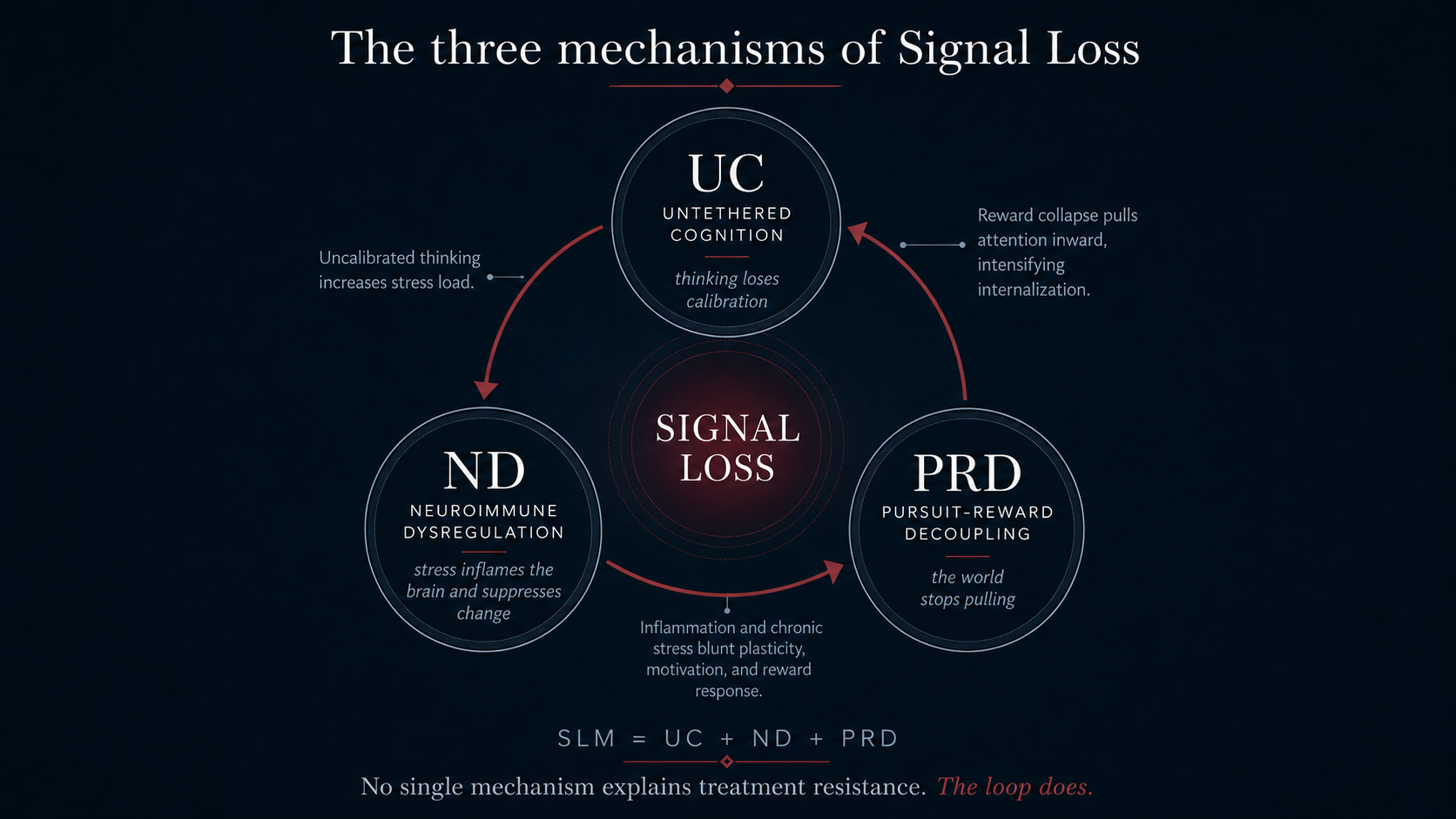
Together they form a self-reinforcing loop: uncalibrated thinking, chronic stress, inflammation, reward collapse, deeper internalization. The series describes that loop and explains why it endures.
Essays 1–3 · The reframe
- Why Your Depression Might Not Be a Disease Genetic and metabolic research points to depression, anxiety, and PTSD as overlapping symptom clusters drawn from shared biology, which breaks the standard disease model.
- The Untethered Mind How human cortical expansion, paired with the loss of real-world constraint, lets internal simulation drift from reality and produce rumination, anxiety, and cognitive instability.
- The Achievement Paradox Why the same architecture collapses differently in high achievers, burned-out strivers, and post-achievement lives, depending on how constraint is added or stripped away over a lifetime.
Essays 4–6 · The mechanism
- Neuroimmune Dysregulation: Inflammation as Lock-In, Not Side Effect How chronic stress drives an inflammatory cascade that suppresses neuroplasticity and freezes maladaptive patterns in place, which is why insight alone so often fails.
- When Nothing Feels Worth Doing How sustained cortisol elevation downregulates dopamine signaling and collapses motivation, and why trying harder cannot bring it back.
- The Three-Level Collapse Untethered cognition, neuroimmune dysregulation, and pursuit-reward decoupling combine into one self-reinforcing system, which is what makes the pattern persist and resist treatment.
Essays 7–10 · Intervention
- Choosing Interventions Without Magical Thinking A framework for selecting interventions, and why otherwise sensible approaches fail when applied at the wrong biological moment.
- Psychedelics as Windows, Not Solutions Why psychedelics reliably open temporary plasticity windows by resetting autonomic balance, and why disruption on its own rarely produces durable change.
- Constraint Installation During Plasticity Windows How precisely timed, embodied, and relational constraints can recalibrate the simulation machinery and reward systems while the brain is still able to rewire.
- Why Integration Fails Reads clinical-trial relapse data as a dataset, shows that plasticity windows are actively closed by dedicated biological machinery, and argues that the usual model of integration works at the wrong level.