What the No Is Protecting
"I don't do drugs" is a complete answer. It is also, sometimes, a locked door with something behind it.

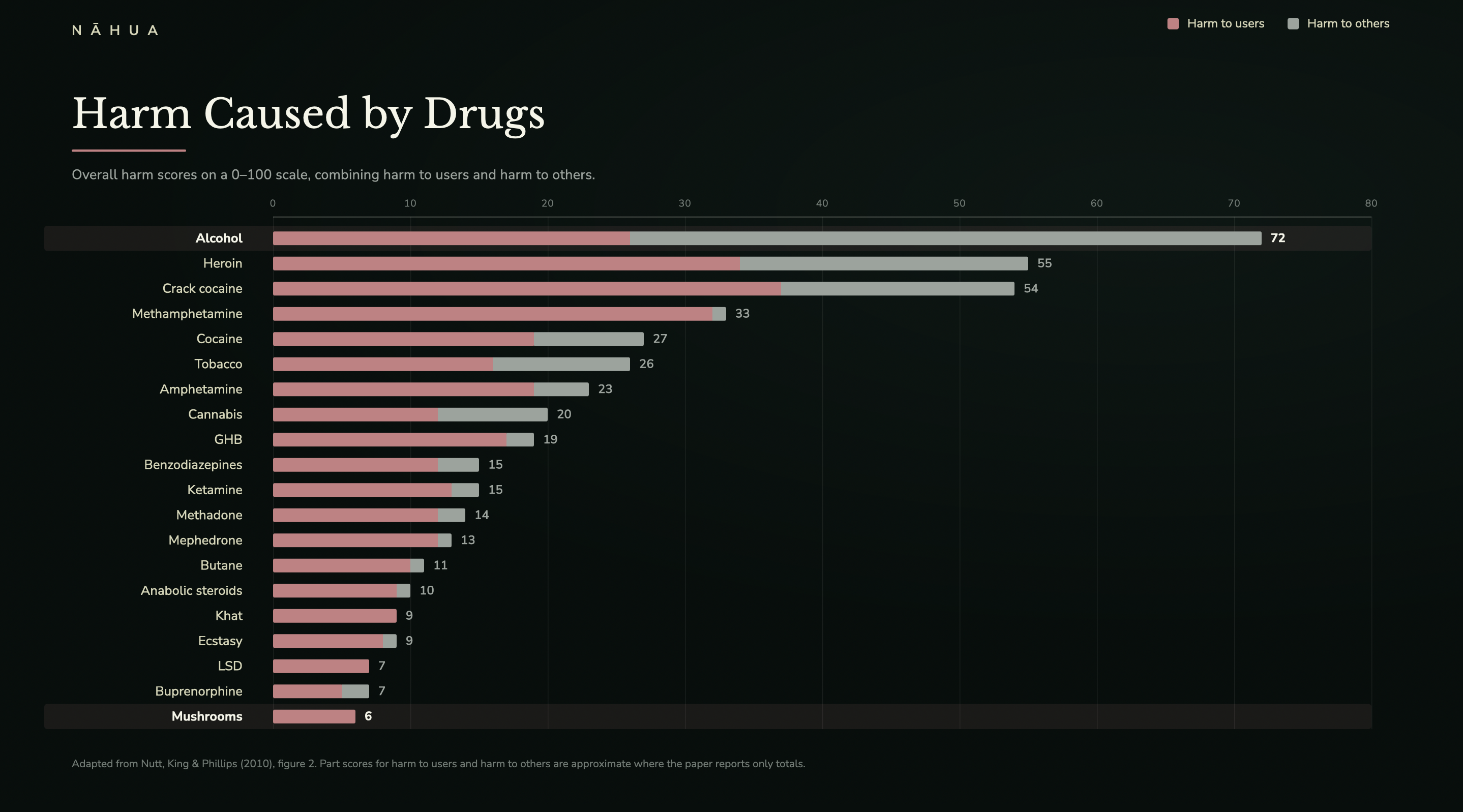
When someone asks me about Nāhua and then tells me they don't want to do drugs, I treat the statement as final. I don't cite the safety literature. I don't mention that when Nutt's group ranked twenty drugs by total harm, alcohol sat at the top of the table and psilocybin mushrooms sat at the very bottom, which means the wine they had with dinner outscores the mushroom by a wide margin. I don't explain that the entire premise of the work collapses without genuine willingness, that expectancy effects and receptor biology conspire to make a coerced psychedelic experience nearly worthless as a therapeutic tool.
I say some version of "then it's not for you," and I mean it. The no is a complete answer. It requires no justification, no footnotes, no defense. This is operational policy at Nāhua and it is also my personal conviction. Nobody should take a mind-altering compound because someone else thinks they should.
But what I have noticed, frequently enough that I no longer consider it coincidence, is that often the person who says "I don't do drugs" keeps asking about Nāhua. The no ends the transaction, but the circling continues. They ask about the retreat, the protocol, the science, the guests. They send me articles. They bring it up again at the next dinner. "I don't do drugs" holds firm while something behind it keeps pressing against the door. I have come to believe these two facts belong in the same sentence: the no is sacred, and the fear underneath it is discussable. In my head, they are no longer contradictory. They are merely uncomfortable together.
The discomfort comes from a misreading of what "I don't do drugs" is often really about. "I don't do drugs" sounds pharmacological, and for most drugs it would be. Declining methamphetamine because of what methamphetamine does is simply good reasoning. But notice what happens when the same sentence is asked to cover psilocybin, a compound that sits at the very bottom of the harm rankings the sentence implicitly invokes. The refusal hasn't consulted any data about the mushroom. It has consulted the drugs category, and the category is doing the heavy lifting.
A no that cannot distinguish between the most and least harmful substances on the table is not a verdict on a molecule. It is a verdict on a word, and that can go two ways. Sometimes the word marks a line the person drew on purpose and there really is no subtext beneath it: a value, a family history, a considered preference about how they want to meet their own mind. That no is clean to the bottom, and no quantity of safety data has any business pushing on it. But sometimes the word is carrying something it would rather not say in the open, something closer to: I don't want to lose control. I don't want buried material to move. I don't want to become the kind of person who does this. Or, in its most entrenched form: I don't want to find out that part of my life is more defended than alive.
That last fear deserves its own examination, because it explains something the others don't: why the fear is so durable. The acute fears are manageable. People who run companies and sit on boards are not, in the main, terrified of six difficult hours. They have survived worse quarters. The fear that actually bolts the door is downstream of the experience entirely. It is the fear that the psychedelic trip actually works.
Consider what "working" means. A psychedelic experience, done seriously, in protocol, with preparation and integration, is a signal event. It can restore contact with material a person has spent decades keeping functionally offline. And insight, once it arrives, is not decorative. Insight creates obligations. What it surfaces about your work, your friendships, your marriage cannot be unseen, and you do not get to choose which way it points. The fear imagines it pointing one way, toward the door. It does point there sometimes. But at least as often it points back inward, toward repair, toward the people already in the room. A frictionless life depends on certain questions staying unasked, and the machinery that keeps them quiet is expensive, invisible, and extremely good at its job. Six hours that introduce signal into that system are not a risk to the evening. They are a risk to the arrangement.
None of this means the thing behind the door is terrible. Fear plays a trick. It treats its own intensity as evidence. If I am this afraid of what I’ll find, the reasoning goes, there must be something down there worth the fear. But fear is not a reliable witness. It can make an ordinary room feel haunted if the door has been locked long enough.
Some people do this work braced for the floor to give way, only to find a room that needs air, light, and attention, not demolition. Not nothing, of course. You may come back with things to repair: how you parent, how you love, how you lead, what you have built, what you have neglected, what you have asked your own competence to conceal. Most people come back with a list. But a list is not a catastrophe. The trip might surface something you have to act on. It might just as easily return the verdict you stopped letting yourself hope for, which is that you are, in fact, okay. The fear cannot tell you which, and that uncertainty is what it is guarding.
I have written elsewhere about what the frictionless life costs to build; this is what it costs to defend.
This is why I take the no seriously even when I can't tell which kind it is. Some part of the person saying it may have done the math correctly. Something could be disturbed. When a life is defended, it is defended against something real, and that defense was built by a competent adult for reasons that made sense at the time. Maybe we should worry a bit less about whether the door is irrational and a bit more about whether the door is still protecting the person or merely protecting the arrangement. Only the person behind the door can tell the difference.
Everything I have written so far could be read as a technique. A clever man who wanted to maneuver people past their refusal could deploy this exact frame: honor the no loudly, then go to work on the fear beneath it. The taboo against questioning someone's no exists because that maneuver is real, common, and ugly. In the context of mind-altering compounds it is disqualifying. The moment consent becomes compliance, the premise collapses. There is no version of this work that remains intact once consent becomes persuasion.
But the taboo has a cost that goes mostly unexamined. A rule that forbids questioning the no also forbids understanding it, and that protection extends to the avoidance hiding behind the boundary. The taboo shelters the defended no exactly as faithfully as it shelters the clean one. It cannot tell them apart. Only the person who said no can do that, and only if someone is willing to make the distinction available without attaching an agenda to it.
So the entire ethical weight comes down to a single property of the question: direction. A directional question treats the no as an obstacle to topple. A non-directional question points nowhere. It treats the no as settled and offers the person a look at their own architecture, which they are free to decline as completely as they declined the mushroom.
The difference is audible. "What are you really afraid of?" is directional. It is an accusation wearing curiosity's clothes, and the person hearing it knows immediately that their no has been reclassified as a symptom. The other version asks for nothing and leads nowhere in particular:
"Would it be useful to understand what the no is protecting?"
Some people will say no to that too. That answer is also complete.
Reference
Nutt, David J., Leslie A. King, and Lawrence D. Phillips. 2010. “Drug Harms in the UK: A Multicriteria Decision Analysis.” The Lancet 376 (9752): 1558–65.
Essays on treatment resistance, altered states, and the conditions under which change becomes possible.
Subscribe