The Timescale of Healing: When Ancient Wisdom Meets Modern Precision
What kratom, coca, and the opium poppy reveal about the cost of ignoring ancestral knowledge
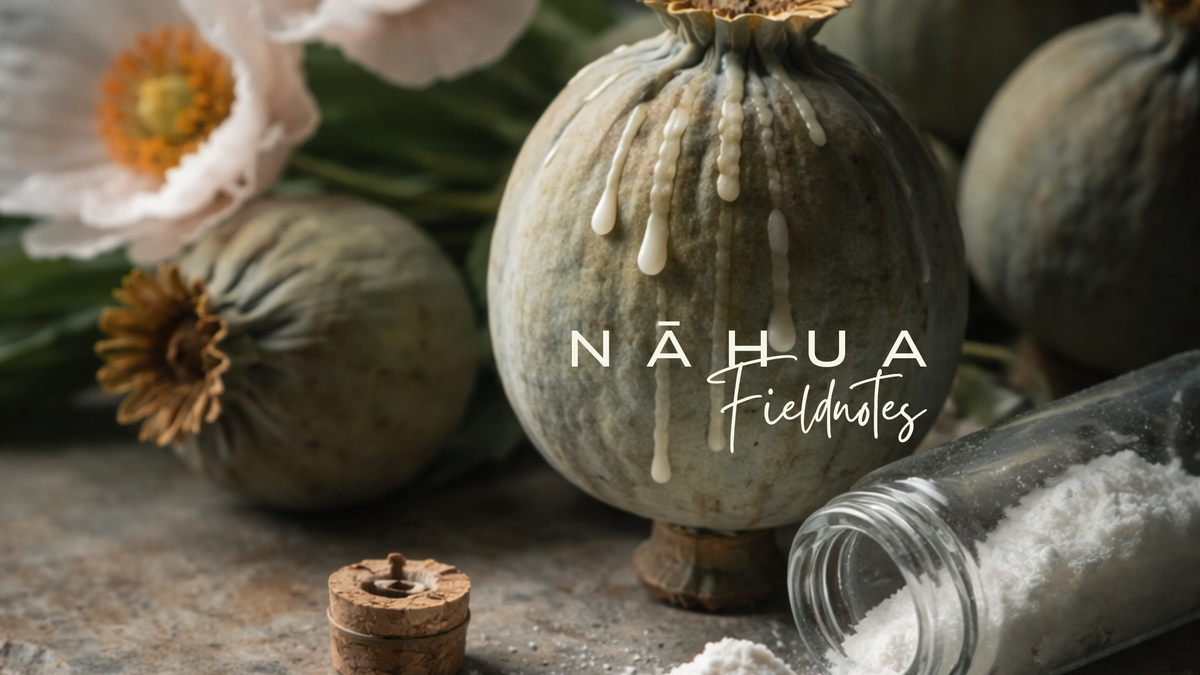
You are a researcher in 1804, and you have just done something that will change medicine forever. You've isolated morphine from opium, the first alkaloid ever extracted from a plant. Pure, potent, precisely dosed. A triumph of chemistry over messy botanicals.
Within decades, the opium poppy, used across cultures for millennia, becomes suspect. A danger. Criminalized. But its extract? That’s medicine.
Two hundred years later, we're about to do the exact same thing with kratom.
Dr. Chris McCurdy sees it coming. In a recent conversation with Andrew Huberman, this University of Florida pharmacologist laid out the pattern with unsettling clarity: isolate the compound, amplify the effect, criminalize the plant, lose the knowledge. Rinse and repeat.
Coca leaf → cocaine. Whole plant → purified alkaloid. Traditional use → street drug → banned substance.
We've been here before. We know how this story ends. So why do we keep telling it?
Many of the insights in this essay emerged from the July 21, 2025 Huberman Lab podcast featuring Dr. Chris McCurdy, whose lab is working to understand kratom before we make the same mistakes we made with coca.
The Numbers That Should Humble Us
500 million years: roughly how long plants have been evolving chemical defenses
300,000 years: how long modern humans have existed
200 years: how long we've had modern chemistry
That's a ratio of 2.5 million to 1,500 to 1.
We're trying to understand half a billion years of evolutionary chemistry and 300,000 years of human cultural learning using methods that are barely two centuries old. And we wonder why we keep missing something essential.
Deep Time: The Chemistry That Wasn't Meant for Us
Land plants crawled onto dry ground around 470 million years ago. They've been locked in chemical warfare ever since: plants versus fungi, plants versus insects, plants versus everything that wanted to eat them.
Psilocybin didn't evolve to expand human consciousness. It evolved to keep slugs away from mushrooms. Nicotine wasn't designed to help humans focus. It's an insecticide that happens to hit our neural pathways just right. Mitragynine, the main alkaloid in kratom, emerged as a defense mechanism that accidentally modulates human opioid receptors.
These compounds represent 500 million years of evolutionary trial and error, selection pressure beyond our comprehension, biochemical strategies tested across geological time. Every alkaloid profile is a chemical fingerprint of survival itself.
And then humans show up.
Cultural Time: The Foragers Who Paid in Blood
"There are old mushroom foragers and bold mushroom foragers, but no old bold mushroom foragers."
That joke contains a universe of human suffering and knowledge. Every traditional medicine represents generations of careful observation, systematic experimentation, and (let's be honest) people dying to figure out what was safe and what wasn't.
For roughly 300,000 years, modern humans have been running distributed clinical trials that no modern institution could replicate. Multi-generational studies. Thousands of participants across hundreds of generations. Cultural evolution preserving what worked, discarding what didn't.
Traditional cultures didn't just discover that certain plants could heal. They developed frameworks for when, how, and why to use them. Dosing protocols calibrated across centuries. Preparation methods that maximized benefits while minimizing harm. Social safeguards that prevented abuse.
Consider kratom in Southeast Asia: workers chewed leaves during specific parts of the workday, in amounts that provided energy without intoxication, within communities that understood the boundaries. This wasn't primitive medicine.
It was systems engineering across multiple generations.
Scientific Time: The Two-Century Sprint
Modern chemistry begins with Lavoisier in the 1780s. The first alkaloid isolation, morphine from opium, happened in 1804. Everything we call "modern pharmacology" fits within roughly 200 years.
Two centuries sounds like a long time until you stack it against 500 million years of plant evolution and 300,000 years of human cultural development. We're essentially trying to reverse-engineer the work of geological time using the research methods of a few human generations.
And those methods are extraordinary. Reductionist science gave us controlled trials, isolated variables, reproducible results, mechanisms of action. It revealed how psilocybin affects 5-HT2A receptors, when neuroplasticity windows open and close, which brain networks modulate during peak experiences.
We know that psychedelics create measurable periods of heightened neural flexibility because of reductionist research. We know these windows close predictably over days to weeks because scientists isolated variables and tracked changes over time. The integration protocols we use at Nāhua exist because researchers spent decades mapping the biology of transformation.
But here's what 200 years of scientific method struggles with: understanding why long-standing systems worked before we knew the mechanisms. And more importantly, learning from them before we destroy them.
The McCurdy Model: Studying Wisdom Before We Lose It
McCurdy's lab is taking a different approach to kratom. Instead of immediately isolating mitragynine and 7-hydroxymitragynine to see what they do in isolation, they're studying the whole leaf first.
Map the complete alkaloid profile. How do dozens of compounds interact? What are the natural "brakes" built into the plant matrix?
Understand traditional preparation. Why did cultures develop specific methods for drying, grinding, and brewing? What did they know that we don't?
Preserve dosing intelligence. Ancestral users developed complex knowledge about timing, quantity, and context. That's data, not folklore.
Use reductionist tools to decode holistic knowledge. Employ modern methods to understand why ancestral practices worked.
This isn't anti-science. It's strategically scientific. The goal is using modern precision to decode ancient intelligence before we accidentally destroy it in the name of improvement.
The Pattern We Keep Missing
During their conversation, Huberman made a crucial point about sugar that illuminates the broader pattern: the molecule isn't the problem. Concentration and context determine everything.
Natural sugars in fruit come with fiber, water, micronutrients, and the seasonal rhythms that limited availability. Refined sugar in processed foods delivers massive doses with none of the natural safeguards, marketed to override our satiety signals.
Same molecule. Completely different outcome.
Coca leaf chewed at altitude provides mild stimulation, appetite suppression, and cultural integration within traditional Andean communities.
Cocaine isolated in laboratories delivers concentrated alkaloids with no cultural container, maximized for potency and profit.
Kratom used traditionally in Southeast Asia involves balanced alkaloid profiles, community oversight, and work-rhythm integration.
Kratom extracts sold as instant energy drinks at the local convenience store contain isolated compounds at unknown concentrations with no cultural context, marketed for maximum effect. This is the exact product category the FDA flagged in 2025, and the one the CDC linked to the spike in adverse events through 2025.
The pattern is always the same: isolation amplifies both benefits and harms, usually disproportionately increasing the harms. Traditional cultures weren't crude. They were systems engineers working with longer feedback loops than we can imagine.
Why This Matters for Healing
We're living through a remarkable moment: reductionist science is finally advanced enough to understand why holistic approaches work. We can map the neurobiology of mystical experiences, track the timeline of neuroplasticity, measure the physiological effects of community and ritual.
We're also living through a dangerous moment. We're losing ancestral knowledge faster than we can decode it. Languages disappear. Elders die. Cultural practices get criminalized or commodified. Ask María Sabina.
The future belongs to whoever can hold both truths at once. Traditional cultures solved the integration problem through community reinforcement, structured timing (harvest ceremonies, life-stage rituals, regular gatherings), and meaning-making systems that supported experiences across months and years. Post-industrial cultures need different solutions that serve the same function. Psychological language rather than spirit guides. Neuroscience rather than imported cosmology. Containers designed for the people who will actually inhabit them.
We're not trying to become indigenous. We're trying to become wise.
That means working with forces much larger and older than ourselves. The compounds existed for millions of years before we discovered them. The cultures that used them safely had centuries to calibrate their approaches. Our contribution is precision, not superiority.
Medicine is not invention. It is the strategic alignment of evolutionary, cultural, and scientific timescales in service of human flourishing. At Nāhua, we respect the deep time that created these therapeutic opportunities, the cultural wisdom that learned to navigate them, and the individual time each person needs to integrate transformation into a life that is genuinely their own.
That's what healing looks like when you respect the intelligence that came before you.
References
Huberman, Andrew, host. 2025. Health Effects & Risks of Kratom, Opioids & Other Natural Occurring Medicines | Dr. Chris McCurdy. July 21.
McCurdy, Christopher R., Abhisheak Sharma, Kirsten E. Smith, et al. 2024. “An Update on the Clinical Pharmacology of Kratom: Uses, Abuse Potential, and Future Considerations.” Expert Review of Clinical Pharmacology 17 (2): 131–42.
Prozialeck, Walter C., Bonnie A. Avery, Edward W. Boyer, et al. 2019. “Kratom Policy: The Challenge of Balancing Therapeutic Potential with Public Safety.” The International Journal on Drug Policy 70 (August): 70–77.

Essays on treatment resistance, altered states, and the conditions under which change becomes possible.
Subscribe